
Skip to content Call Us: (918) 355-1391

Root canal treatment removes infected tissue from inside a tooth, disinfects the space and seals it, so the tooth can stay in your mouth instead of being pulled out. At Dentistry For You in Broken Arrow it is one of the more common treatments we do, and almost everything people believe about it is out of date.

What Is Actually Going On Inside the Tooth

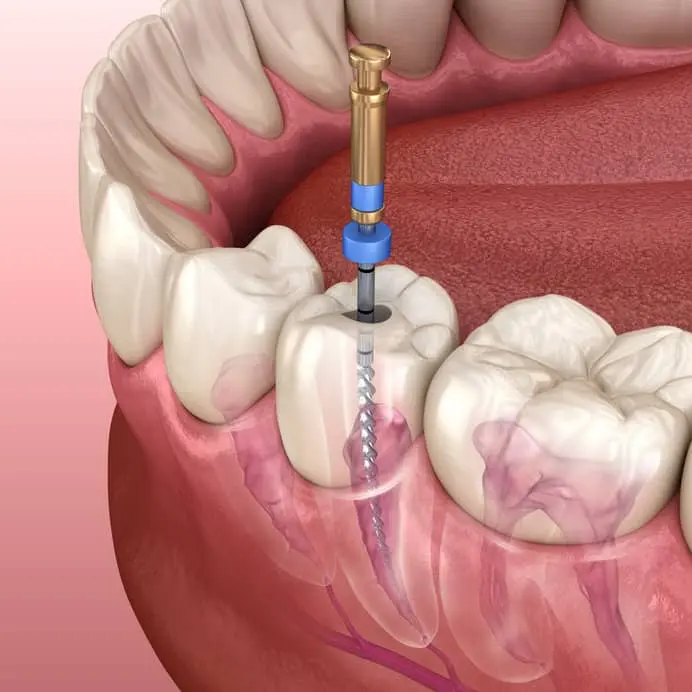
Inside every tooth is a chamber of soft tissue, the pulp, containing the nerve and blood supply. It runs down through canals in each root.

Bacteria reach the pulp through deep decay, a crack, or repeated work on the same tooth. Once they are in, the pulp becomes inflamed and then infected. The chamber is enclosed in hard tissue with nowhere for the swelling to go, which is why the pressure builds and why the pain is so distinctive.

The pulp cannot recover on its own once it reaches that point. There are two ways out: clear the infection and keep the tooth, or remove the tooth.
A dentist working on a patient with a treatment light

Signs You Might Need One

Pain that lingers for minutes after something hot or cold rather than settling straight away. A deep throbbing that gets worse lying down, which is why these are the teeth that wake people at two in the morning. Pain on biting. A tooth that has darkened. A small bump on the gum beside a tooth, which is a sinus tract draining an abscess. Swelling in the face, which needs seeing urgently.

Pain that stops abruptly after being severe is not good news. It usually means the nerve has died, and the infection continues without symptoms until it flares up again.

In Pain Right Now?

Call the front desk and we will find you a time that works.

The Treatment

The tooth is numbed thoroughly, and we check it is properly numb before starting. A rubber sheet isolates the tooth so the area stays clean and dry.

We open the top of the tooth, remove the infected pulp, and clean and shape each canal with fine instruments and disinfecting rinses. The canals are then filled with a rubber-like material that seals them, and the opening is closed.

Some cases are done in one visit and some in two, depending on how much infection there is. If a second visit is needed, medication is sealed inside in the meantime.

Most patients describe it as similar to a long filling. The severe pain they arrived with is usually gone within a day.

Afterwards

The tooth is often tender to bite on for a few days while the tissue around the root tip settles. Over-the-counter pain relief usually covers it, and chewing on the other side for a while helps.

What is not normal is pain that increases after several days, swelling, or a temporary filling that comes out. Call us if any of that happens.

Why the Crown Matters

This is the part people skip, and it is the part that decides whether the treatment was worth having.

A root-treated tooth no longer has its internal blood supply, so it becomes more brittle. It also usually has a large cavity, because that is how the infection got in. A tooth in that condition under full chewing load will eventually split, and a split root cannot be repaired.

A crown wraps the tooth and holds it together. On back teeth it is not optional, and it should be fitted reasonably soon after the root treatment rather than years later.

The Alternative

You can always choose extraction instead. It is faster and cheaper on the day. What follows is the part to weigh: a gap that lets the neighbouring teeth drift, and then the cost of an implant or bridge if you replace it, which is more than the root canal and crown would have been.

Call (918) 355-1391 and describe what you are feeling.

Questions About Root Canals

Is a root canal painful?

The reputation comes from the pain people arrive in, not from the treatment. The tooth is numbed thoroughly first, and most patients say it feels much like having a filling. The severe throbbing that brought you in is usually gone by the next day.

Why not just pull the tooth out?

Extraction is quicker and cheaper on the day, and then you have a gap. Replacing a tooth with an implant or a bridge costs more than the root canal would have, and no replacement works quite as well as a real tooth that has been kept. We will give you both options honestly.

Do I really need a crown afterwards?

On a back tooth, yes. A root-treated tooth has lost its blood supply and is more brittle, and it usually has a large cavity already. Chewing forces crack these teeth. Skipping the crown is the most common reason a successful root canal ends in extraction a couple of years later.

My tooth stopped hurting on its own. Am I fine now?

Probably not. Pain that stops suddenly after being severe often means the nerve has died rather than recovered. The infection carries on quietly and usually reappears later as an abscess. It still needs looking at.

Get the Tooth Looked At

A tooth that throbs at night is usually treatable. Waiting makes extraction more likely.