
Skip to content Call Us: (918) 355-1391

Orthodontic treatment moves teeth into better positions using steady, gentle pressure over months. At Dentistry For You in Broken Arrow that means traditional braces or clear aligners, for teenagers and adults alike.

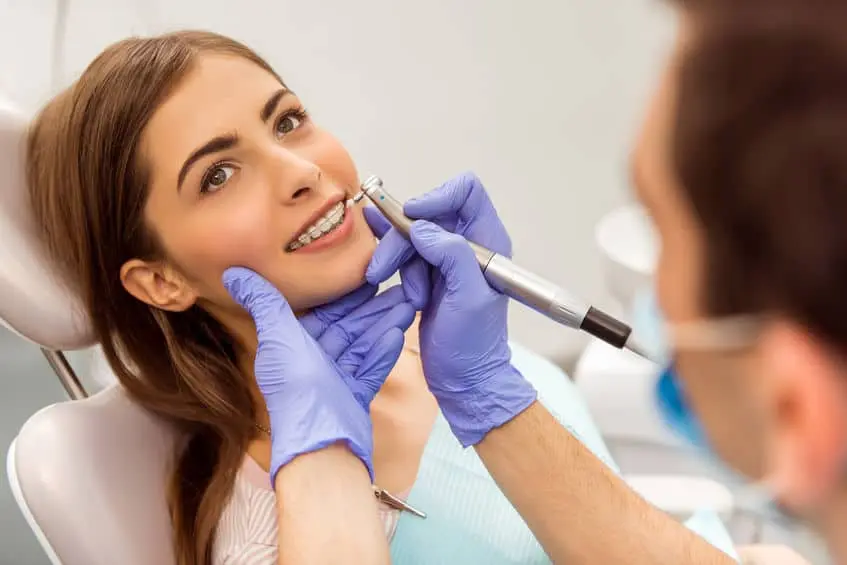
A close view of braces on upper teeth

It Is Not Only About Appearance

Straightening teeth changes how they look, and for most patients that is the reason they come in. There are practical reasons too.

Crowded and overlapping teeth are difficult to clean, so decay and gum disease concentrate in exactly the places a brush cannot reach. A bite that does not meet properly loads certain teeth much harder than others, which wears and cracks them over years. Some bite problems contribute to jaw joint discomfort and to grinding.

A tooth can also drift into a gap left by an extraction, which makes replacing that tooth harder later unless the space is held or reopened.

Traditional Braces

Braces use brackets bonded to each tooth and a wire that connects them. Adjusting the wire at regular appointments applies controlled pressure, and the bone remodels around the roots as the teeth move.

They remain the most versatile option. They handle rotations, significant crowding, bite correction and moving roots as well as crowns, which aligners find harder. They also work regardless of whether the patient remembers anything, because they are not removable.

The downsides are visibility, and that cleaning takes real effort. Brackets and wires create dozens of new places for plaque to sit, so patients in braces need more frequent cleanings and careful technique at home.

Wondering Which Option Fits?

Call the front desk and we will find you a time that works.

Clear Aligners

Clear aligners are a series of thin transparent trays, each slightly different from the last, worn in sequence. Each one moves the teeth a small amount, and you change to the next every week or two.

They are removable, so you take them out to eat and to brush, which means no food restrictions and much easier cleaning. They are also far less noticeable, which is why most adult patients ask about them first.

The catch is compliance. Aligners only work while they are in your mouth, and the requirement is 20 to 22 hours a day. Someone who takes them out for long stretches will simply not get the result, and treatment stalls. It is worth being honest with yourself about that before choosing.

They also have limits. Very complex movements and some bite corrections are better handled with fixed braces.

Children and Teenagers

An orthodontic assessment around age seven is worth having. Not because treatment usually starts then, but because it is the age where a developing problem becomes visible: crowding, a crossbite, teeth that are not coming in where they should.

Catching some of those early allows simpler intervention while the jaw is still growing. Most full treatment still happens in the early teens once the adult teeth are through.

Retainers

This is the part that gets underestimated. Teeth are held in place by fibres that have a long memory, and after treatment they pull back towards where they were. That tendency never entirely goes away.

So retainers are not an optional extra at the end; they are what makes the treatment permanent. Usually that means full-time wear at first and night-time wear indefinitely. Patients who stop wearing them are the ones who end up considering treatment a second time.

Call (918) 355-1391 or use the contact form to book a consultation.

Questions About Orthodontics

Am I too old for braces?

No. Teeth move at any age, as long as the gums and the bone supporting them are healthy. Treatment can take a little longer in adults because the bone is denser, and a good many adults choose clear aligners for appearance.

How long does treatment take?

Simple cases, such as mild crowding of the front teeth, can be a few months. A full case involving the bite is usually eighteen months to two years. We will give you an estimate after looking at X-rays and models rather than guessing at a first glance.

Braces or clear aligners?

Aligners are removable and much less visible, which suits adults and mild to moderate crowding. Fixed braces handle more complicated movements and bite corrections, and they do not depend on the patient wearing them. Aligners only work if they are in for 20 to 22 hours a day, so honesty about that is part of choosing.

Do I have to wear a retainer forever?

In some form, yes. Teeth drift back towards where they started, and that tendency never fully disappears. Most people wear a retainer full time at first and then at night indefinitely. Stopping is the single most common reason people need treatment twice.

Book an Orthodontic Consultation

We will look at what needs moving and tell you which approach suits it.