
Skip to content Call Us: (918) 355-1391

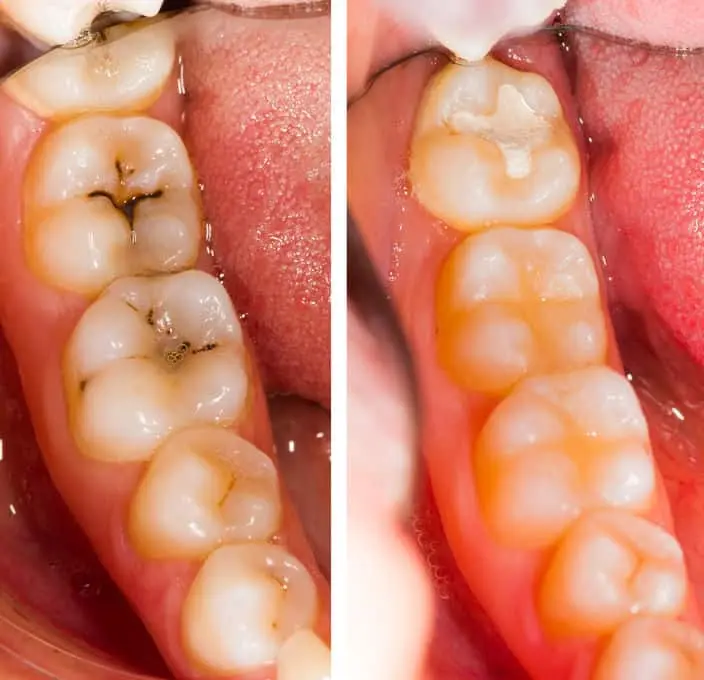
A filling repairs a tooth damaged by decay or a small fracture. At Dentistry For You in Broken Arrow we place tooth-coloured composite fillings, which bond to the tooth rather than being wedged in by shape alone, so less healthy structure has to be removed to hold them.

A composite filling being shaped

How Decay Actually Works

Bacteria in plaque feed on sugars and produce acid as a by-product. That acid dissolves minerals out of the enamel. Between meals, saliva neutralises the acid and puts some of those minerals back.

Decay happens when that balance tips the wrong way often enough. This is why how frequently you eat sugar matters more than how much: a dessert finished in ten minutes is one acid attack, while a sweet drink sipped through an afternoon is a continuous one.

At the very earliest stage, before there is a hole, the process can be reversed with fluoride and better cleaning. Once the surface breaks, it cannot repair itself and needs a filling.

Why Catching It Early Matters So Much

Decay does not stay the same size. Enamel is dense and it moves through slowly, but once it reaches the softer dentine underneath it spreads much faster.

The progression is unforgiving. A small cavity is a filling. A larger one is a bigger filling that weakens the tooth. Larger still and the tooth needs a crown. If it reaches the nerve, it becomes a root canal, and if infection goes further, an extraction.

The same tooth, caught at the right moment, is the cheapest and easiest of those. That is the entire argument for six-month checkups.

Think You Have a Cavity?

Call the front desk and we will find you a time that works.

What Happens at the Appointment

The tooth is numbed. We remove the decayed tissue, which is softer than healthy tooth, and shape the remaining structure. The area is kept dry, because composite will not bond properly to a wet surface.

The composite goes in as a putty and is built up in layers, each hardened with a curing light. The shade is matched to your tooth. Once it is built up, we shape it to the original contours and check your bite by having you tap together and grind side to side, adjusting until it feels normal.

Most single fillings take under an hour, and composite sets hard immediately, so there is no waiting period before you can eat. The numbness lasts a couple of hours and it is worth being careful with your cheek and tongue until it wears off.

Composite and Amalgam

Composite is the default here. It matches the tooth, bonds to it so the preparation can be more conservative, and needs no undercuts to stay in place.

Amalgam, the silver material many people have from childhood, is hard-wearing and was the standard for decades. If you have sound amalgam fillings, there is generally no reason to replace them. Doing so removes more tooth for no clinical gain. When one cracks, leaks or has decay under it, that is the moment to change material. There is more on the metal-free dentistry page.

When a Filling Is Not the Answer

There is a limit to how much of a tooth a filling can replace. Past roughly half the chewing surface, a large filling starts to act as a wedge and the remaining walls of the tooth are at risk of splitting.

At that point an onlay or a crown is the better answer, because both hold the tooth together rather than pushing it apart. We will tell you when a tooth has reached that point rather than placing a filling that is likely to fail.

Making Fillings Last

Most fillings fail at the margin, where the filling meets the tooth, because that junction is where new decay starts. Clean between your teeth daily, because the contact points between teeth are exactly where a brush never reaches.

If you grind your teeth, a night guard protects fillings as well as natural enamel. Call (918) 355-1391 or use the contact form.

Questions About Fillings

How do I know if I need a filling?

Often you do not, which is the point of regular checkups. Early decay causes no symptoms and shows on an X-ray long before you feel anything. By the time a tooth is sensitive to cold or sweet things, or food keeps packing into one spot, the cavity is already well established.

Does getting a filling hurt?

The tooth is numbed first, so you should feel pressure and vibration rather than pain. The numbing injection itself is the part most people mind, and a topical gel beforehand takes the edge off that. Tell us if you feel anything sharp and we will add more.

How long do fillings last?

A composite filling commonly lasts seven to ten years or more. It depends on size, where it is, whether you grind, and how well the area is kept clean. No filling is permanent, so they get checked at every visit.

Why does my tooth still feel odd after a filling?

Mild sensitivity to cold for a couple of weeks is normal, particularly after a deeper filling. What is not normal is pain on biting, or a filling that feels high when your teeth meet. That usually means the bite needs a small adjustment, which takes a few minutes. Call us rather than waiting it out.

Get It Looked at Before It Grows

A cavity caught early is a filling. Left alone it becomes a crown or a root canal.